


CRAIG BROWN
THE STANDARD RISES
Part of the “Winning Pedigree” Series by Michael Pilsitz
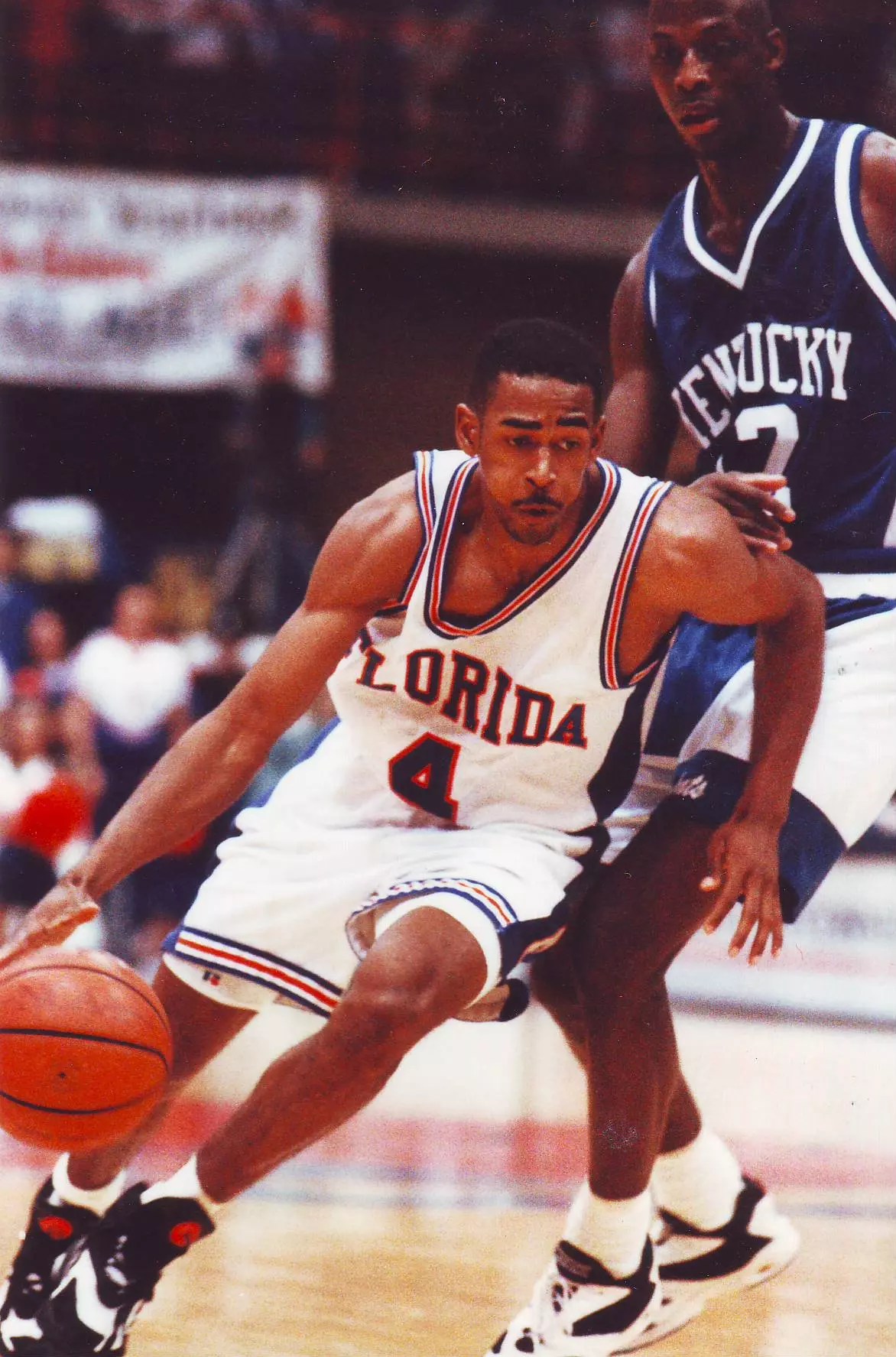
The Steelton Guard
From Roller Drive to the FINAL FOUR
“When Florida broke through to its first Final Four, a Steelton guard was in the middle of it — steady, tested, and built for March.”
Out of that same tested foundation and “Winning Pedigree” came Craig Brown.
A Steelton product.
A guard shaped in a place that embodied toughness, discipline, and accountability.
And when his moment came, he didn’t just reach the SEC and high-major basketball—
he helped carry a program to its first Final Four.
Since that run. Florida has become one of the modern college basketball powerhouses.
The Player
Craig Brown
School: Florida Gators
Years: 1990–1994
Position: Shooting Guard
Role: Lone captain / senior starter / primary scorer
Brown’s story matters because he was far more than a contributor.
Florida University describes him as the leader-shooting guard of the 1993–94 team and notes that he was the first signee of the Lon Kruger era. As a senior, he started all 37 games, averaged 14.8 points, 4.9 rebounds, shot 45.8% from the field and 43.2% from three, while setting a school record with 89 made threes that season. He finished his career as the program’s all-time leader in three-point field goals at the time and still ranks among the school’s top all-time scorers.
This was a Steelton guard leading from the front.
NCAA Tournament Impact
This is where the story becomes unmistakable… Legendary to say the least.
1994 NCAA Tournament — Final Four
Florida’s 1993–94 team reached the first Final Four in school history, defeating James Madison, Penn, UConn in overtime, and Boston College before falling to Duke 70–65 in the national semifinal. Florida’s historical recap calls it one of the most unexpected and important runs in program history.
And Craig Brown was central to that breakthrough.
Florida credits Brown with 17 points and 9 rebounds in the upset of No. 2 seed UConn, then a season-high 21 points in the Elite Eight win over Boston College, the performance that helped send the Gators to the Final Four. He was named MVP of the NCAA East Region.
So when Craig Brown’s name is placed in this Steelton lineage, it should be said clearly:
He did not just appear on a Final Four roster.
He shoot Florida’s way there.
1991-1994 Florida University
| Career Awards, Stats & Honors -1991 SEC All-Freshman Team -1994 All-SEC -1994 All-SEC Tournament -1994 NCAA Tournament All-Region MVP -1994 7th in SEC Points (14.8 PPG) -11.6 PPG in 122 games | Led the SEC in 1994 -Games Played (37) -Minutes Played (1245) *3rd in NCAA Top 10 in SEC in 1994 -Field Goals (7th) 191 -3pt FG made (3rd) 89 -Points (7th) 548 -Assists (9th) 117 -Steals (8th) 57 -FG% (5th) .565 |
A mere tournament appearance is something kids dream about.
This was a Final Four run, Florida’s first-ever Final Four run. And the team that put the program on that stage for the first time, was lead by a Roller.
Right in the middle of it was a player from Steelton, Pennsylvania.
A starting guard.
A captain.
A record-setting shooter.
A player trusted to deliver when the games were biggest.
That is where this story widens beyond Florida.
Because Craig Brown wasn’t just building a college résumé.
He was extending a pattern of Roller hoopers.
The Steelton Connection
Step back from the bracket and the numbers.
Look at the pipeline.
Gil Reich proved Steelton belonged on the national stage with Kansas.
Jon Krovic reinforced it with deep Cinderella runs at Virginia Military Institute .
Greg Manning elevated it in the Atlantic Coast Conference.
Rod Brookin carried the standard into the modern Big East era.
Then Craig Brown pushed the story into one of the sport’s clearest landmarks:
the Final Four.
And he did it in a role that tells you everything you need to know about the town that helped shape him.
Because the same traits kept traveling:
- toughness
- accountability
- work ethic
- poise under pressure
- the discipline to master a role and own it
Brown’s skill was elite shooting.
But what made that skill matter was everything underneath it.
Steelton had already been teaching that part for generations.
The Shift in the Story
Craig Brown’s chapter is powerful not just because of where he reached—
but because of when he reached it.
By the early 1990s, Steelton was no longer being reinforced by the same stable industrial structure that had defined earlier generations.
The foundation of the town was being tested.
The mills were unstable.
The economy was changing.
The daily structure that once shaped so many working-class homes was no longer as fixed as it had been.
And yet—
the results were still showing up.
That is what makes Brown such an important bridge figure in the “Winning Pedigree” series.
His story suggests that by 1994, Steelton basketball identity had become bigger than the conditions that created it.
The environment had shifted.
But the standard still traveled.
And in Brown’s case, it traveled all the way to the Final Four.
Legacy Placement
Reich built it.
Krovic reinforced it.
Manning elevated it.
Brookin carried it into a new era.
Craig Brown brought it to the Final Four.
That’s his place in the Winning Pedigree line.
Not as a footnote.
Not as a supporting name.
But as a major chapter in the proof that Steelton didn’t just produce college players—
it produced players who could become central figures on one of the game’s biggest stages.
Closing
Craig Brown’s story is not just about records, though the records matter.
It is not just about the Final Four, though that matters too.
It is about what Steelton kept producing even while the town itself was being tested.
A winner.
A leader.
A guard built for pressure.
A player capable of taking a historic team where it had never gone before.
When Florida broke through in 1994, a Steelton product was not standing on the edge of the moment.
He was in the middle of it.
And once again, the message was clear:
Steelton didn’t just produce tournament players.
It produced players that were must see TV on CBS Sports come who could March.
Read more of the Winning Pedigree Series:

 Michael Pilsitz
Leave a comment